
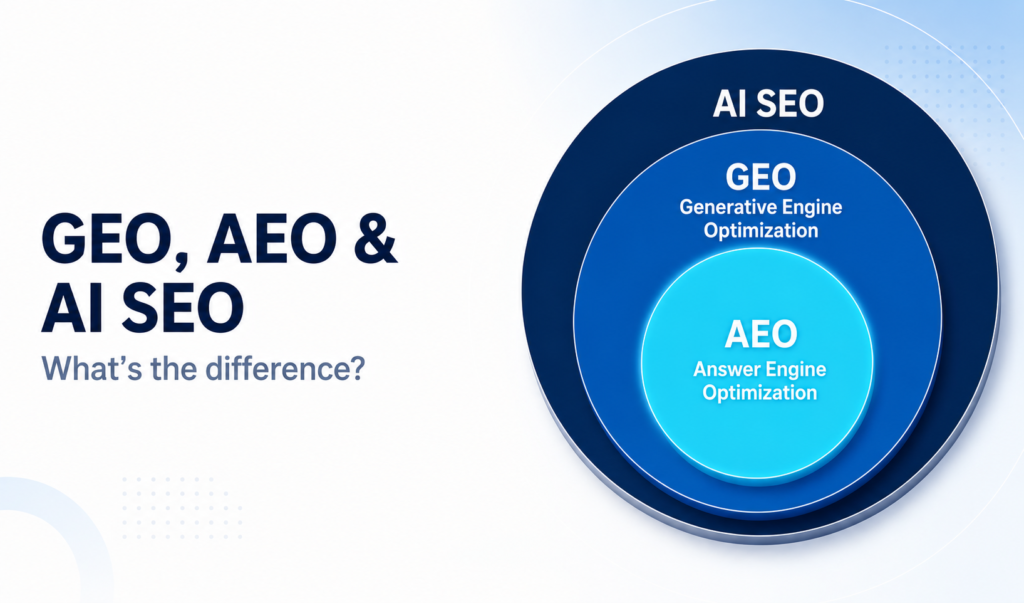
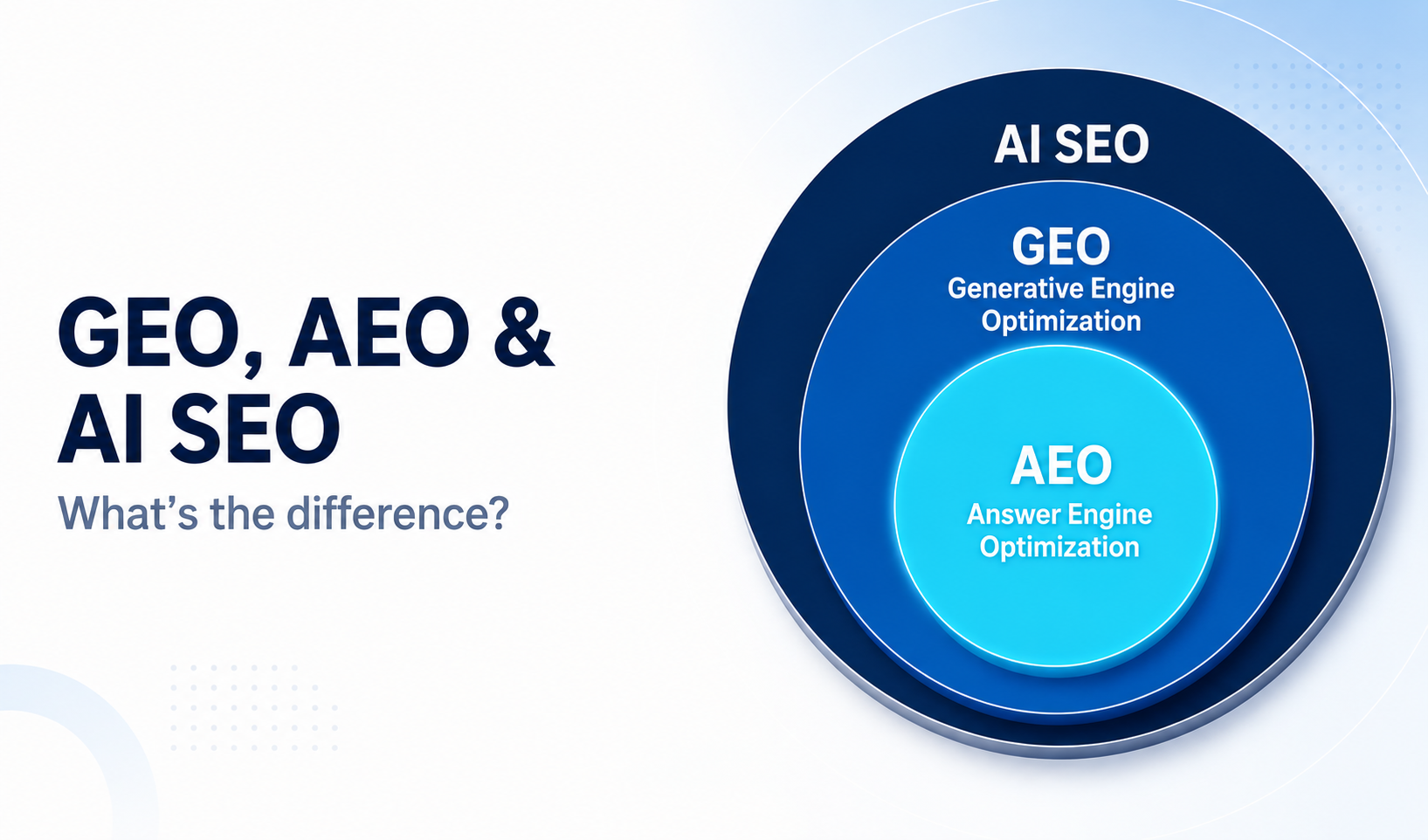
GEO, AEO and AI SEO are often used interchangeably, but they optimise for different outcomes. AEO (Answer Engine Optimisation) aims to make your content the direct answer to a question. GEO (Generative Engine Optimisation) aims to have your brand cited and named inside an AI-generated response. AI SEO is the umbrella term covering both, plus conventional search engine optimisation. Drawing on One Marketing Solutions’ experience serving Hong Kong brands since 2018, the question most companies actually need to answer is not which one to choose, but which layer they are currently stuck on.
- The three differ in how success is defined: AEO measures whether you were answered with, GEO measures whether you were cited and named, AI SEO measures overall visibility.
- They do not replace each other. Conventional SEO is a precondition for GEO, because an AI system cannot use content it cannot crawl.
- A 21-query test run in August 2026 found that the three AI platforms select sources on completely different logic, so optimising for one platform is unlikely to move the other two.
- GEO, AEO and AI SEO compared in one table
- What is AEO, and what problem does it solve?
- What is GEO, and why does it matter in 2026?
- How does AI SEO relate to conventional SEO?
- Where should a Hong Kong business start? Three tests
- Hong Kong market test: how do AI platforms choose sources?
- Frequently asked questions
GEO, AEO and AI SEO compared in one table
The clearest difference between the three is how each defines success. AEO measures whether your content was used as the answer. GEO measures whether your brand was cited and named. AI SEO measures visibility across every search surface. The table below sets out four dimensions side by side.
| Dimension | AEO | GEO | AI SEO |
|---|---|---|---|
| Core approach | Break content into self-contained question and answer units, supported by structured data | Build citable, authoritative content and strengthen brand entity signals | Combine conventional SEO, AEO and GEO across the whole search chain |
| Primary goal | Become the direct answer to a question | Be cited and named inside a generated response | Stay visible across every search surface |
| Typical surfaces | Featured snippets, voice assistants, question boxes | ChatGPT, Perplexity, Gemini, Google AI Overviews | All of the above, plus Google and Bing organic results |
| Success metric | How often your answer is extracted | Citation rate, brand mention count, share of the source list | Organic traffic, conversion, cross-platform visibility |
| Content format | Short answers, FAQs, definitions, lists | Sourced long-form content, statistics, expert commentary, case studies | Mixed, allocated by page intent |
Scroll the table horizontally to view all columns.
In one sentence: AEO gets an AI system to answer with you, GEO gets it to cite you, and AI SEO gets you found across every search surface.
What is AEO, and what problem does it solve?
AEO is the practice of structuring content into answer units a machine can extract directly, so that a search interface can respond without the user needing to click through. The point is not length. The point is whether each passage still holds up when read on its own, outside the surrounding context.
In practice this usually means three things. First, the opening paragraph under each heading is the answer itself, kept short enough to stand alone. Second, headings use the phrasing a real person would type, such as “how much does this service cost” rather than “service pricing”. Third, the content is supported by FAQPage structured data so machines can tell which text is the question and which is the answer.
The limits of AEO are equally clear. It handles questions with a definite answer: price, timeline, procedure. When a user asks something that requires comparison and judgement, such as which provider suits their situation, that falls outside what AEO can address.
What is GEO, and why does it matter in 2026?
GEO is optimisation aimed at generative AI engines. The goal is that when an AI system synthesises multiple sources into a single response, your content is among the sources cited and your brand is named. The difference from AEO is that GEO is not satisfied by a correct answer. It requires the answer to come from you.
The academic basis for the term comes from a Princeton-led research paper published in 2023 and later presented at KDD 2024, GEO: Generative Engine Optimization. The study tested a range of content adjustments against generative engine visibility. Three showed the clearest effect: adding cited sources, adding specific statistics with attribution, and adding quotations from named experts with their titles. The same study found that keyword stuffing reduced visibility rather than improving it.
That last finding marks a real departure from conventional SEO practice. Parts of traditional SEO are built around satisfying a ranking algorithm. GEO is closer to making content that is genuinely worth citing.
How does AI SEO relate to conventional SEO?
AI SEO is an umbrella term covering AEO, GEO and conventional search engine optimisation. It does not replace conventional SEO. To a large extent it is built on top of it.
The reason is practical. AI tools still draw heavily on web pages that can be crawled and indexed. If a site blocks crawlers, loads slowly, or uses a disordered heading structure, an AI system cannot retrieve the content either. Google’s own documentation on structured data makes the same point in a different context: structured data exists to help machines understand a page, and that requirement only becomes more pronounced in AI scenarios.
The sensible order is therefore to fix the technical foundation first, then address content structure, and only then invest in external authority signals. Skipping the first step and going straight to content production is usually wasted effort.
Where should a Hong Kong business start? Three tests
You do not need to decide between AEO and GEO at the outset. Work through the three questions below to identify which layer you are stuck on, and the direction becomes obvious.
- Is your brand entity data consistent? Take four items: company name, address, phone number and founding year. Compare them across your site header and footer, your structured data, your Google Business Profile and each social platform. A single discrepancy forces an AI system to spend extra effort establishing who you are. This step costs the least and benefits all three directions at once.
- Does your content answer what clients actually ask? Write down the ten questions clients raise most often, then try to find each answer on your own site. If you cannot find it, or the answer is buried mid-way through a long article, the problem is content structure. That is AEO territory.
- Has any third party written about you? Media coverage, industry roundups, chamber of commerce directories, professional listings. Research indicates AI systems are considerably more inclined to cite third-party sources than a brand’s own domain, which means this layer cannot be solved by publishing more of your own articles. That is GEO territory.
Once all three are answered the direction is usually clear. Most Hong Kong small and medium-sized businesses are stuck on the first two layers, not the third.
Hong Kong market test: how do AI platforms choose sources?
Most published discussion of GEO relies on overseas data. On 4 August 2026, One Marketing Solutions ran a Hong Kong market test using the following method: seven Hong Kong GEO and AI SEO keywords, each asked once on Google AI Overview, Perplexity and ChatGPT, for a total of 21 queries. All queries were asked in Traditional Chinese, in incognito windows, with no follow-up questions and identical wording each time.
The three platforms differed sharply in the kinds of sources they drew on.
| Platform | Predominant source type |
|---|---|
| Google AI Overview | Chinese-language third-party roundup articles. One single roundup appeared in three of the seven queries. |
| Perplexity | Third-party roundups alternating with providers’ own explainer pages. |
| ChatGPT | Google Business Profile listings first, followed by English-language authority sources. Academic papers were cited four times across the seven queries. |
One finding is worth particular attention for businesses operating in Hong Kong. When we asked the equivalent of “what is the difference between GEO, AEO and AI SEO”, ChatGPT returned five reference sources, all of them English-language international sources, with no Hong Kong source at all. This held even though the question itself was asked in Traditional Chinese. On the Google AI Overview side, only one of seven sources was from Hong Kong, with the remainder from Taiwan and mainland China.
Across the same 21 queries, Google AI Overview and Perplexity together cited academic papers zero times and international media zero times over 14 queries. ChatGPT alone cited academic papers four times across seven. The three platforms select sources on entirely different logic.
This has a direct practical consequence. Optimising for one platform is unlikely to produce a response from the other two. Read the other way: if your business is based in Hong Kong and your target clients are using ChatGPT, the completeness of your English-language content and your Google Business Profile may matter more to whether you are mentioned than your Chinese-language content does.
A note on interpretation: this is a single measurement across a sample of 21 queries, which is not sufficient to characterise the Hong Kong market as a whole. Source selection on these platforms also changes over time. We re-run the same questions using the same method each month, and treat the results as a trend indicator rather than a conclusion.
Frequently asked questions
Which matters most: GEO, AEO or AI SEO?
They are not ranked against each other. Each addresses a different situation. AEO applies when a user asks a specific question and expects a direct answer. GEO applies when an AI system produces a synthesised response and lists its sources. AI SEO is the umbrella term covering both plus conventional search optimisation. For most Hong Kong businesses the practical approach is to satisfy all three requirements within the same body of content, rather than choosing one.
What exactly separates AEO from GEO?
The output format. AEO aims for your content to become a short, direct, self-contained answer, typically surfacing through voice assistants and featured snippets. GEO aims for your brand to be cited and included in the source list when an AI system produces a longer synthesised response. AEO measures whether you were answered with. GEO measures whether you were cited and named.
Once we implement GEO, can we stop doing conventional SEO?
No. AI tools still rely heavily on pages that can be crawled and indexed. If a site blocks crawlers, loads slowly or has a disordered structure, an AI system cannot retrieve the content either. Conventional SEO has not been replaced. It has become a precondition for GEO. Further detail is available on our AI SEO service page.
Where should a Hong Kong SME begin?
Begin with brand entity consistency. If your company name, address, phone number and founding year differ between your website, your structured data, your Google Business Profile and your social platforms, an AI system will struggle to establish who you are. This step costs the least, benefits all three directions simultaneously, and should be completed before investing in content or external links.
How can we tell whether AI systems are citing us?
It has to be measured manually. No tool currently automates this fully. Select a fixed set of target keywords, ask each one once on ChatGPT, Perplexity and Google AI Overview, and record whether the response links to your site, whether your brand name is mentioned, and which competitors were cited. Re-run the same questions on the same date each month. Only then can changes be compared meaningfully.
How long before results appear?
Technical and structured data changes can generally be completed and re-indexed within one to two months. Changes in AI citation and recommendation typically require three to six months of continued tracking, because each platform refreshes its sources on a different cycle and third-party coverage accumulates slowly. Any claim guaranteeing AI recommendation within a short period cannot be substantiated.
Start with a diagnostic
Having read the comparison, the practical next step is not to pick one of the three. It is to establish how your brand is currently understood by AI systems. That figure becomes the baseline against which every subsequent change is measured.
One Marketing Solutions provides AI SEO and GEO services in Hong Kong, covering brand entity consistency, structured data deployment, content structure optimisation and third-party authority signals.
Request a free AI visibility diagnostic